
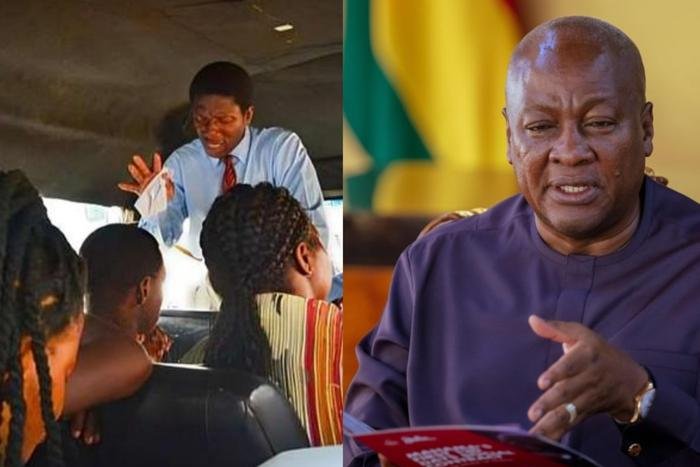
MAHAMA: “NO ONE SHOULD PREACH OR SELL IN A MOVING VEHICLE”
President John Dramani Mahama has emphasized that preaching and selling activities should not take place inside moving vehicles, regardless of a person’s religious beliefs.
According to the statement featured in the graphic, people can preach or engage in such activities when the vehicle is stationary.
The issue raises questions about road safety, passenger comfort and the need to ensure that activities inside public transport do not distract drivers or inconvenience passengers.
While religious expression and commercial activities are part of everyday life in Ghana, should there be clearer rules governing what people can do inside commercial vehicles?
“I STAND BY MY PROPHECY! BAWUMIA WILL NEVER BECOME PRESIDENT” — PROPHET THOMAS IDDRISU
Prophet Thomas Iddrisu is making headlines with a bold political prophecy concerning former Vice President Dr. Mahamudu Bawumia’s presidential ambitions.
In a statement attributed to the prophet, he insisted that he stands by his prediction, adding that if it fails, people should chase him away.
The declaration has sparked questions about the role of prophecy in Ghanaian politics, especially as political figures and religious leaders continue to attract public attention with their predictions about the country’s leadership.
ASEM OO! WHY DOES EVERYONE WANT TO BE A LAWYER, BUT NOT AN ENGINEER?
Ghana has produced over 5,000 lawyers in the past five years, raising questions about the career choices of young people and the country’s demand for professionals in different fields.
The question is simple: Why do so many people aspire to become lawyers, while engineering seems to attract less attention? Is it the prestige, financial opportunities, societal recognition, or the opportunities available after graduation?
Ghana needs lawyers to uphold justice, but it also needs engineers to build roads, bridges, industries, technology and the infrastructure that drives national development.
Are young people choosing careers based on passion, financial rewards, or social status? And what can be done to make engineering more attractive to the next generation?
GHANA EVACUATES CITIZENS FROM LIBYA, MYANMAR AND CAMBODIA — OKUDZETO ABLAKWA
Ghana has evacuated citizens from several countries, including Libya, Myanmar and Cambodia, according to Foreign Affairs Minister Samuel Okudzeto Ablakwa. He also mentioned South Africa while highlighting Ghana’s evacuation efforts.
The statement highlights the government’s efforts to assist Ghanaians facing difficult circumstances abroad and underscores the importance of protecting citizens wherever they may be.
For Ghanaians living and working overseas, access to consular support and timely assistance during emergencies remains a major concern.
IBRAHIM MAHAMa: “AS GHANAIANS, WE SHOULDN’T THINK OR HOLD OURSELVES IN LOW ESTEEM JUST TO BECOME SLAVES TO FOREIGNERS.”
Ghanaian business mogul Ibrahim Mahama has shared a powerful message about national pride, self-worth, and the need for Ghanaians to recognise their own value rather than look down on themselves in the presence of foreigners.
His statement highlights an important conversation about how Ghanaians perceive themselves, their abilities, and their position in the global community. For many, the message is a reminder that being Ghanaian should never be a reason to feel inferior, whether in business, employment, education, or any other field.
The statement also raises questions about how Ghana can create an environment where local businesses thrive, homegrown talents receive the recognition they deserve, and young people are encouraged to believe in their abilities.
While international partnerships and foreign investment can contribute to national development, the discussion is about ensuring that such relationships are built on mutual respect rather than feelings of inferiority. Ghanaians must be able to engage with the rest of the world confidently while protecting their dignity, interests, and national identity.
For the youth, entrepreneurs, and emerging professionals, the message is particularly relevant. Confidence, hard work, innovation, and a belief in one’s potential can play an important role in building a stronger economy and a more self-assured society.
The bigger question is: Are Ghanaians giving themselves the respect and confidence they deserve, or have we become too dependent on foreign validation?

No Comments